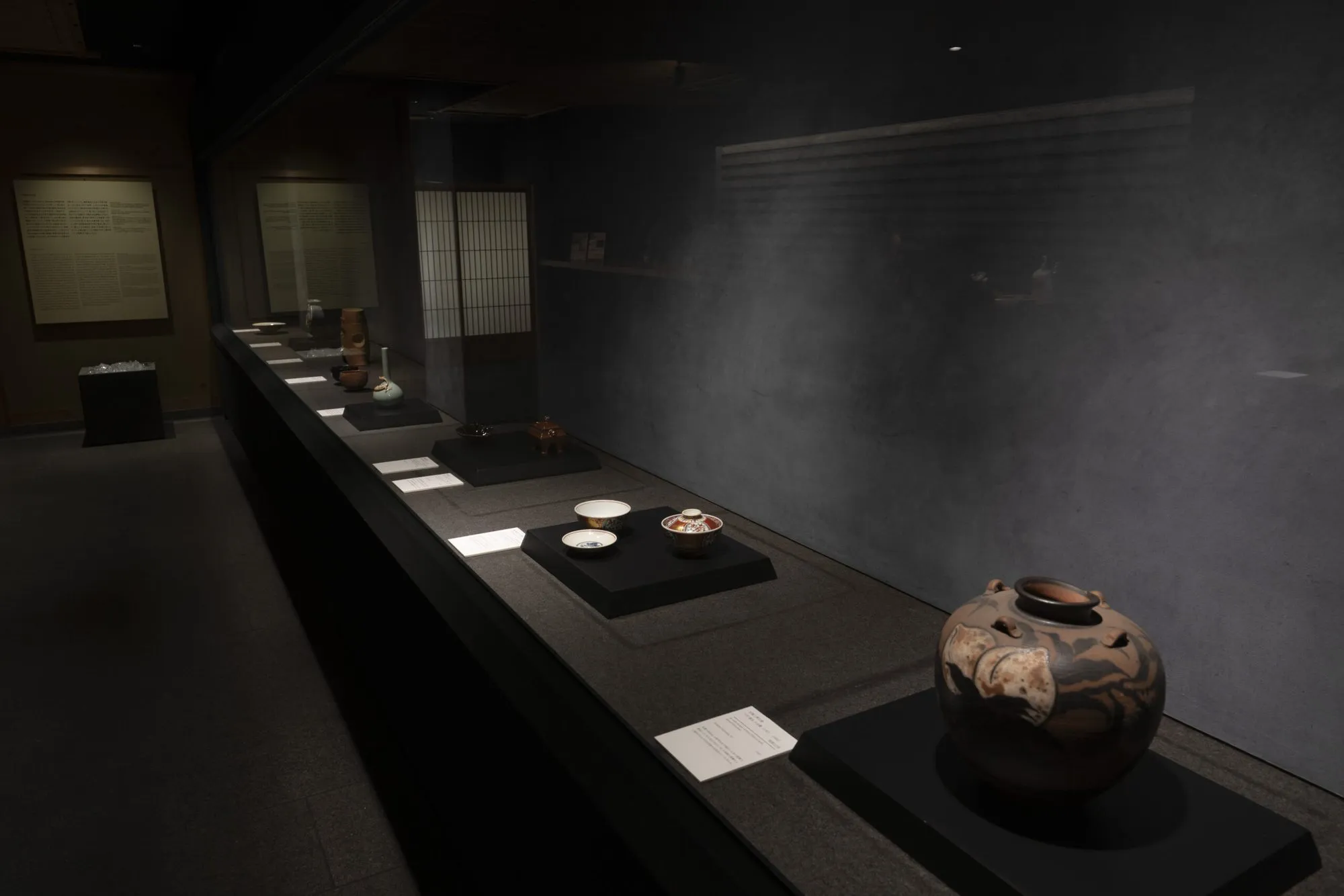
This exhibition shines a spotlight on legendary ceramic artists who were active during the Showa era in Higashiyama Gojo, a district of pottery makers. Alongside an exhibition of their works at the Yuzo Kondo Memorial Museum, we explore their everyday lives and personalities.
What were the everyday lives of these legendary artists like, and how did they make their works? Did they also have connections with one another?
With the cooperation of their surviving family members, who are also members of WAN wan ONE, we conducted interviews about stories passed down through their families and episodes they remember fondly. We will share a fresh view of Gojo's ceramic history from within our own community.
Interviewer
Aiko Shimizu
In addition to organizing ceramics events at Gojozaka Shimizu, a shop that handles the ceramic works of her grandfather, father and younger brother, she organizes the Kyoto Gojo Pottery Market, which connects various shops in the Gojo area with young ceramic artists.
Her activities explore how Gojo's history of successive innovations can be inherited and passed on to the next generation.
Completed the doctoral program at Kyoto Institute of Technology.
PhD
Co-author of The Modern Era of Kyoto's Traditional Crafts (Shibunkaku, 2012) and Kyoto: Networks of Modern Art and Crafts (Shibunkaku, 2017).
Michihisa Inoue
Profile
- Shimizu: How are you related to the artist whose work you have lent to the Legends Exhibition (for example, grandchild or daughter)?
- Inoue: Grandson.
- Shimizu: Have you taken over the artist's former studio and continued making work there? When do you feel traces of their presence?
- Inoue: I still use the studio.
When things such as brush holders and holders for trimming tools are nearby in the workspace. - Shimizu: Please tell us about your usual activities and style. Where do you see that artist's influence, or what aspects do you consciously draw on or carry forward?
- Inoue: I work in porcelain, with a particular commitment to forming pieces on the potter's wheel.
I place great importance on the refinement of a work, aiming for a style that combines dignified poise with intensity.
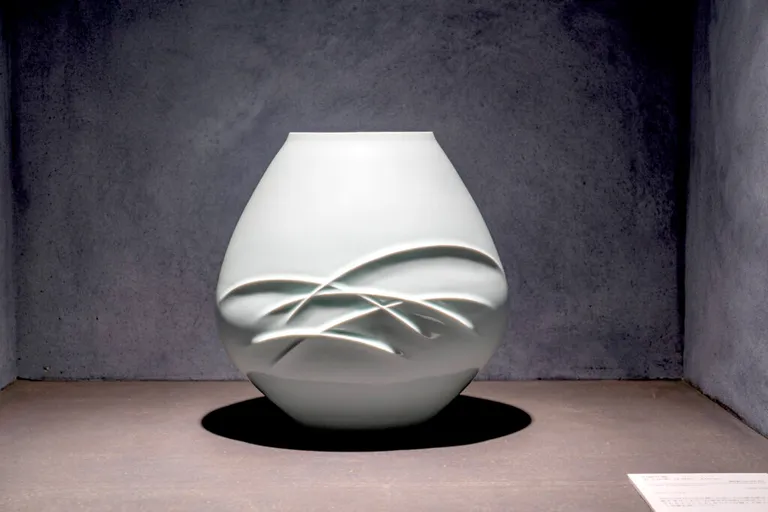
White Porcelain Vase Showa 20s (1945–1954)
Interview

Ms Shimizu
Could you tell us about the work you have lent to this exhibition?

Mr Inoue
The work I am exhibiting this time is a white porcelain vase that was shown at Nitten.
I think it was made in the Showa 20s, around 1945–1954.
Ms Shimizu
How old would your grandfather have been then?
Mr Inoue
He was born in the Meiji 20s, so perhaps around forty.
Ms Shimizu
A time when his creative practice was reaching maturity.
Mr Inoue
Probably. About my age now. [laughs]
Ms Shimizu
And in the first year of Showa, which last year's exhibition focused on, he would still have been in his late teens.
Mr Inoue
Yes, that's right. And my father was born in Showa 22, in 1947.
He used to say that he often exhibited in two-person shows with Yasutaka Shimizu.
Ms Shimizu
Those two seem to have very little in common…
Mr Inoue
One was with the Japan Kogei Association and the other with Nitten. They worked in quite different fields of ceramics, but they were the same age, and Manjudo introduced them. Apparently they exhibited together every year. I was surprised to learn that my father had a connection like that. They did not seem like two people who would have much to do with one another. In the ordinary course of things, their paths would not cross, would they? This is unrelated, but I have also heard they served together on the PTA at Rakuto Junior High School.
Ms Shimizu
So there really are connections we know nothing about.
Mr Inoue
Sometimes, as you happen to remember things and talk about them, you discover for the first time that people were connected in that way. I also wonder whether the pottery trade around here might be a little different if Manjudo were still here today. It was a shop that really championed individual artists.
Ms Shimizu
You really never know what will happen. Returning to your grandfather, are there any other stories about him that have been passed down to you?
Mr Inoue
I do not know very much myself, but the biggest thing was that he belonged to the ceramic artists' club led by Rokubei Kiyomizu VI. He was very much Rokubei's right-hand man. Rokubei was chairman, and my grandfather and Mr Shinkai were vice-chairmen. Then came Seitoku Kawai, and in those days Uichi Shimizu and the previous Bunsai Ogawa, too. And in the next generation after them, my father and Mr Kano…
Ms Shimizu
So it was quite a hierarchical world, organized by seniority.
Was the work you have lent us this time also exhibited at Nitten?
Mr Inoue
Yes. Come to think of it, we still have a calligraphy board on which my grandfather wrote, ‘White porcelain is my very life.’ Our family pursued porcelain very deeply—white porcelain, in particular. He left some words that go, ‘This white porcelain shining in confinement… captivated by its rays of light…’ I sometimes borrow those words for my own solo exhibitions. [laughs]
Ms Shimizu
Your grandfather followed the path of an individual artist, but did he also work as a kiln producer?
Mr Inoue
We were originally a pottery producing tableware for kappo restaurants, but apparently my grandfather could not be satisfied with that. He became an individual artist and stopped making the kiln's products. That seems to have been when we became a family of artists.
His father was apparently called Genshiro. The brothers lived together and all made tableware.
There were craftspeople working for us, too, so when my grandfather decided to close the pottery business, he introduced two of our craftspeople to the vocational training school. Apparently they went on to teach there. I have heard that many people who attended the school learned their skills from the craftspeople who had worked with us.
Ms Shimizu
They must have been exceptionally skilled craftspeople.
Mr Inoue
Apparently they were very skilled.
I have also heard a story involving Kazuo Yagi.
Somehow, my grandfather was asked to come and teach ceramics at Omi Gakuen in Shiga Prefecture. Apparently there was already a program for making plates, rice bowls and other vessels, but someone suggested they try making something more artistic. My grandfather seems to have been busy at the time, and he said, ‘I cannot really go myself, so I will introduce a young fellow who is working hard in Gojo.’ The person he introduced was Kazuo Yagi, or so I have heard. When people talk about Yagi and the experiences and influences he had at Omi Gakuen, my grandfather only introduced him, but… even knowing he had some connection to it makes me happy.
Ms Shimizu
I have heard about Yagi's involvement with children with disabilities at Omi Gakuen. So behind that was a small, local connection of the kind you would only find here.
Mr Inoue
About three years ago, Omi Gakuen called. They were publishing a book for their hundredth anniversary or something like that, and asked how Yagi had come to teach there. They said, ‘We understand that Haruo Inoue introduced him. Is that true?’ That is how the story has come down to us, but I do not actually know what happened myself. [laughs]
Ms Shimizu
Even when I am told there is hardly anything to talk about, actually sitting down and talking reveals unexpectedly interesting stories that grew out of everyday life, and connections particular to this neighborhood. Thank you very much.
Sozan Suwa
Profile
- Shimizu: How are you related to the artist whose work you have lent to the Legends Exhibition?
- Suwa: She was my great-aunt.
- Shimizu: Have you taken over the artist's former studio and continued making work there? When do you feel traces of their presence?
- Suwa: I work in the same studio. Many of the works, plaster molds and documents left by the second Sozan survive. I also study the tea ceremony at the same place she did, and during lessons I can hear stories about her works and the things associated with them.
- Shimizu: Please tell us about your usual activities and style. Where do you see that artist's influence, or what aspects do you consciously draw on or carry forward?
- Suwa: Alongside the color of celadon passed down through the generations, I think the forms and sizes of the works left by the second Sozan are a precious inheritance. Many of the pieces remaining in our home have imperfections, so they also let me sense her process of trial and error.
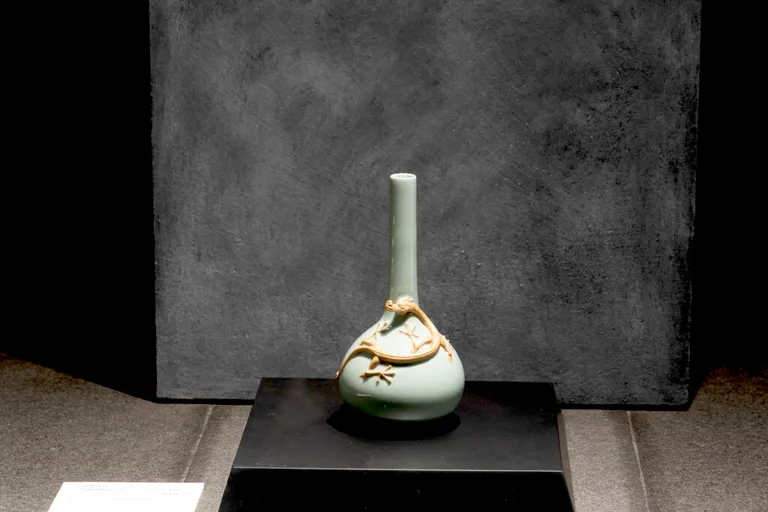
Celadon Flower Vase with an Applied Dragon Around Showa 15 (1940)
Interview
Ms Shimizu
When was this particular work made?

Ms Suwa
There are very few works whose dates we know. Pieces were normally fired without recording the year. This one is also illustrated in a catalog, where it is dated Showa 15, or 1940. It is five years earlier than Showa 20 and does not quite fall within that period, but this is about the only piece from around then whose date we know.
Ms Shimizu
Thank you.
In fact, a work from 1940 is precious in its own way: it comes from before the war intensified, before making work became increasingly difficult.
Ms Suwa
Even during the war, she was certified under the Maru-gei designation, so materials were supplied and she seems to have been able to make work despite the times. Our family had connections with people in the military. I think it was a struggle, but I feel they may have given her some help.
Ms Shimizu
The first Sozan is widely known, but we have fewer opportunities to learn about the second. Are there any stories you have heard about her?
Ms Suwa
Actually, I know very little… Speaking of the war, she adopted a boy from among her relatives as her successor. She raised him from around elementary or junior high school age, and he attended what I think was Kyoto Higher Technical School, the predecessor of Kyoto Institute of Technology. He was in the equestrian club and could ride horses, so around the time he was due to graduate, he was sent to war. He died of illness while serving in China. I have heard that she was deeply saddened then.
The family of her younger brother, Soho Yonezawa, had two sons, so apparently their second son—my father—was adopted into the family and became her successor.
Ms Shimizu
So that was part of the story behind the succession from the second to the third Sozan.
And your father was also close to the previous Bunsai Ogawa, wasn't he?
Ms Suwa
Yes. They were very close and constantly visited one another. Apparently they promised that whichever of them outlived the other would chair the other's funeral committee.
Tatsuo Morisato
Eldest son of Tadao Morisato
Profile
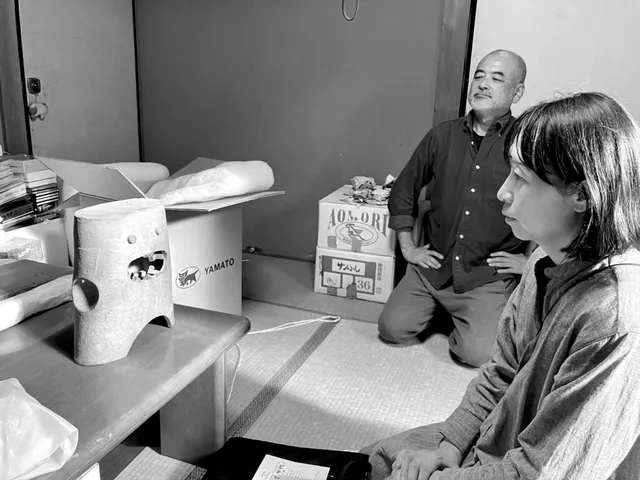
My own studio stands where my father's workplace used to be. But only traces in my memory remain.
I remember secretly going into his workplace when he was out, as a small child, and touching all sorts of tools and works.
I still use whichever of my father's tools from seventy years ago remain usable. Some date back to my grandfather's time.
My father loved telling all kinds of stories, and the ones I heard as a child still remain in a corner of my memory. I think his very presence in that way may be what influences my work and what I remain conscious of when creating it.
My mother also used to say that none of my father's works had ever sold. That made a strong impression on me as a child, and left me feeling that I had to make ceramics that would sell.
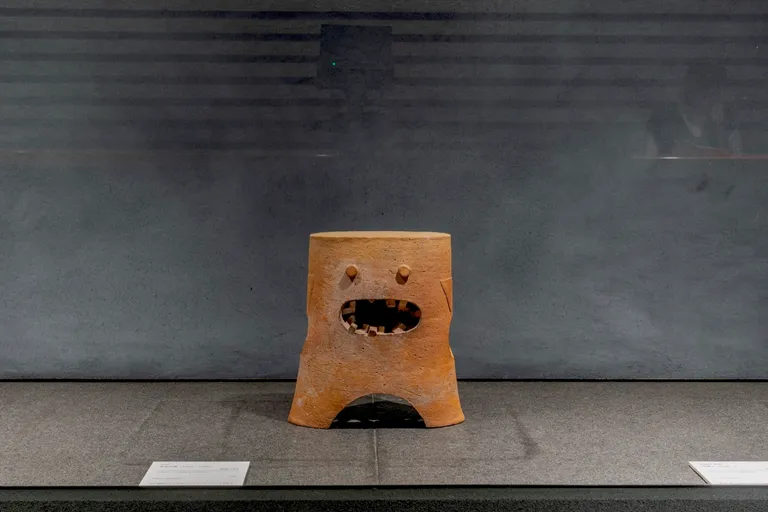
Work Showa 33 (1958)
Interview
Ms Shimizu
Could you tell us how this work came to be made?

Mr Morisato
Looking through various examples, it seems that most of the work he was making in this period was of this kind. If you look closely, it is a little like a face, isn't it?
Ms Shimizu
Yes, it is.
Mr Morisato
With hands and feet and so on, the overall direction seems to have been like that. At first, he seems to have made things resembling works by Hikaru Yamada and various other artists, but around then he appears to have turned in this direction.
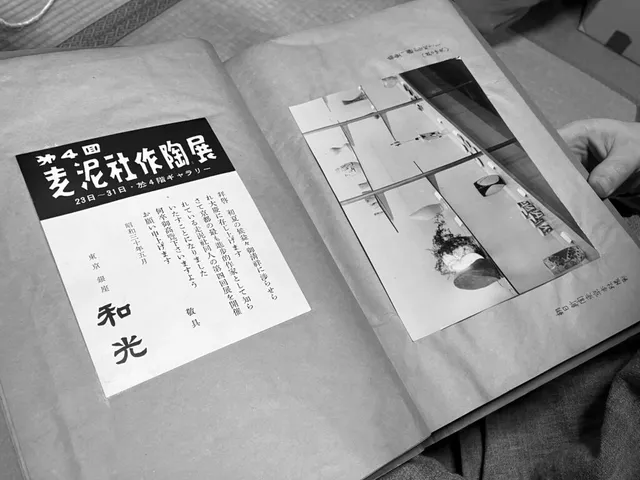
My father left Sodeisha in Showa 42, in 1967, when my younger sister was born. There were three of us: my older sister, me and then my younger sister. I do not think that was the main reason, but my younger sister has always been conscious of it and has feelings about it. She wanted to keep at least one of his works, so we kept just this one and donated the rest.
In fact, there is a photograph from the time showing Kazuo Yagi with this work, and it has sometimes been mistaken for a work by Yagi.
Then, just as we had kept only this one piece of my father's at home, we were approached about the Legends Exhibition. I am very grateful that people here in Gojo now have an opportunity to see his work.
Ms Shimizu
We, too, knew his name as someone who had belonged to Sodeisha at that time, but had never actually seen his work. Thank you for this valuable opportunity.
How old was he in the Showa 20s, the period covered by this exhibition?
Mr Morisato
He was still in his late teens and twenties. Quite a lot of work survives from 1955. A curator has also told us that he made a concentrated body of very good work between 1955 and 1960. To have your peak at twenty-four is almost unimaginable now. It amazes me.
Ms Shimizu
After leaving Sodeisha, did he stop making this kind of work altogether?
Mr Morisato
There was a time when he made odd, hand-built things at home, but after leaving he no longer went as far as firing them.
In those days, my uncle Toraku's workplace was across the way. My father would get some earth from him, add water himself to make clay, and make strange things, but in the end they were never fired. I think they have probably been disposed of by now.
He died at forty-eight, you see. If he had lived a little longer, perhaps he might have had time to make things again.
I think making those works was probably becoming a burden for him. But because he had not made vessels before, he never managed to make a successful transition to them either. It is a shame.
I do think my father must have struggled considerably in his own way at the time. From childhood I sensed that life seemed hard for him, and that feeling stayed with me. But looking back now, I also think he might have enjoyed it more if he had carried on all the same.
Speaking of vessels, he did make teacups when people asked him to. They are quite peculiar teacups, though.
Ms Shimizu
The work has such a pure quality, and still feels approachable today.
This is the first time I have heard about your father, but if he had lived longer and continued making even a little work like this… there seems likely to have been a demand, and perhaps he could have enjoyed making it, too.
Mr Morisato
If only he had been able to manage all those different things well. I do not know whether this work would have been well received then, either. Today, people might look at it and think it is rather interesting, but I suspect it would not have struck people that way at the time, even if he made it. So I feel it probably did not fit into the production system of those days.
Actually, the person who prompted my father to join Sodeisha was Kozo Kawashima. Kawashima's younger sister married my uncle Toraku. So, in a way, we were related. I think he drew my father in, feeling that since the younger brother was doing that sort of thing, he should come along too. I think that is how he introduced him to Kazuo Yagi. Kawashima was also an early member of Sodeisha.
Ms Shimizu
What did Kawashima do after Sodeisha?
Mr Morisato
He moved to Sumiyama and established what they called a craft village. Rather than a village, it was a workshop and housing like a row of apartments. My uncle moved there, too. Apparently a man around here who made plaster molds and his son, who made ceramics, also moved there with them.
Ms Shimizu
So there were a great many people making ceramics around here at the time.
Mr Morisato
Yes, there were.
The road in front of here was gravel in those days. A lot of people made porcelain, and everyone threw fired clay onto the road. If you excavated the roads around here, you might find almost nothing but pottery. Perhaps vessels made by people who worked here would turn up.
Ms Shimizu
We are planning to focus on the Showa 30s next time. Would it be difficult to show other works by your father?
Mr Morisato
I am just starting to think about sorting them out. There are still some, actually, but none is complete. Like the piece in this exhibition, they have all sorts of little parts attached, and those have come off. It seems I broke them all when I was little…
Ms Shimizu
[laughs]
Mr Morisato
So there are no complete ones. There was actually a work called Insect that won a prize at the Asahi Ceramics Exhibition or something like that, but it was so delicate that various parts have come off, chipped or broken. It is still tucked away somewhere, but it is very badly damaged. I will have another look.